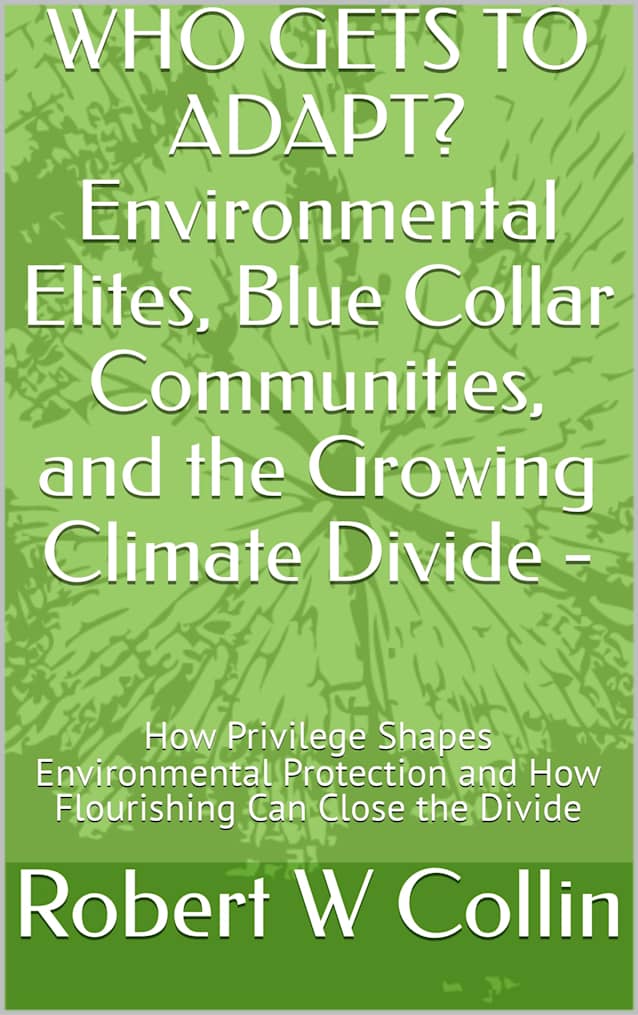
WHO GETS TO ADAPT? Environmental Elites, Blue Collar Communities, and the Growing Climate Divide - : How Privilege Shapes Environmental Protection and ... Education, Adaptation and Flourishing)
About
Who Gets to Adapt?
The Environmental Elite and the Climate Divide
Climate change is no longer a distant threat—it is a sorting mechanism. Centuries of rigid social institutions have prevented environmental elite decisionmakers and organizations from incorporating blue collar communities in the rapidly evolving growth of climate adaptation. It is not that these groups don’t want to, but the social structures do not allow for the recognition of need for this, or their privilege, But climate change has chaged all that.
As heat, floods, wildfires, and insurance retreat reshape daily life, a quiet divide has emerged between those who can adapt and those who cannot. This book exposes how climate resilience is increasingly reserved for an environmental elite—while blue-collar workers, renters, rural communities, elders, and families living paycheck to paycheck are left to absorb the risks.
Drawing on decades of environmental justice scholarship, urban planning, public health research, and real-world case studies, Who Gets to Adapt? reveals how adaptation has become the new frontier of inequality. From fortified neighborhoods and climate-controlled workplaces to insurance withdrawals, zoning decisions, and infrastructure investment patterns, the book shows how protection follows power—often invisibly, often unintentionally, but relentlessly.
This is not a book about villains. It is a book about how we can aspire to flourishing and climate adapt in the future. .
You will discover:
How climate adaptation quietly reinforces class, occupational, and geographic divides
Why blue-collar communities face higher exposure, faster wear, and fewer recovery options
How insurance markets, land-use planning, and capital investment shape who is protected—and who is sacrificed
Why environmental progress narratives often obscure unequal outcomes
How “flourishing” offers a bridge between resilience, dignity, and shared adaptation
Blending data, policy analysis, lived experience, and moral clarity, this book challenges the comforting idea that adaptation is neutral or inevitable. Instead, it asks the harder question: Who decides what—and who is worth protecting?
Written for educators, planners, policymakers, advocates, and concerned citizens, Who Gets to Adapt? reframes climate adaptation as a matter of environmental dignity, labor equity, and intergenerational justice. It does not call for guilt. It calls for recognition—and redesign.
Because the future is being built right now.
And not everyone is being invited inside.